新选组
New Database Shows US Death Penalty Remains as Biased as High Court Ruled in 1972 - DPIC_我的网站

A |
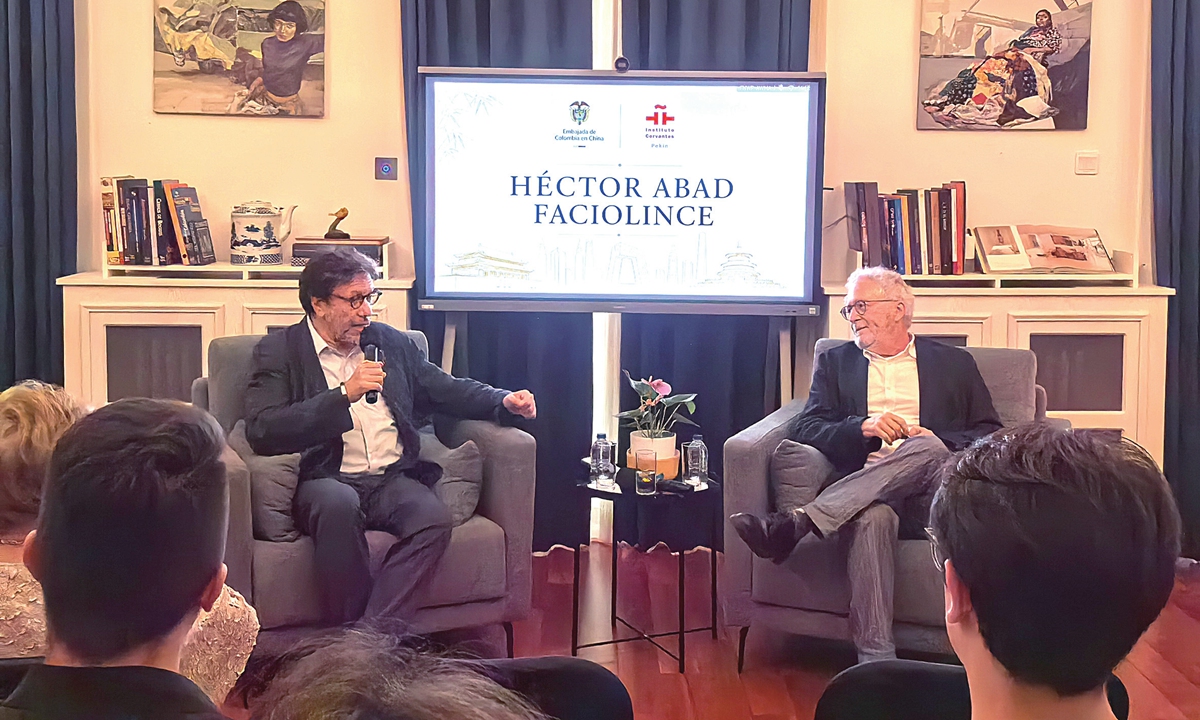
Santiago Gamboa, writer and minister counselor of the Embassy of Colombia in China, (left) and Héctor Abad Faciolince, a Colombian novelist, writer and journalist at a sharing session at the Embassy of the Republic of Colombia in China on August 18, 2026. Photo: Dong Feng/GT
The Embassy of the Republic of Colombia in China hosted a colloquium with Héctor Abad Faciolince, a Colombian novelist, writer and journalist. The writer shared on Tuesday his growth journey from a journalist to achieve his dream as a writer, his observation of the Colombian society and his impression about the changes in China.
In a fully packed hall, Minister Plenipotentiary Jose Fernando Bermúdez Cendales said in his opening remarks that the event is part of an initiative to bring Colombian culture closer to the Chinese public while simultaneously creating new spaces for dialogue and exchange between the two countries.
Bermúdez said that Abad's visit to China offers a particularly valuable opportunity to showcase the richness of our literature and to strengthen the cultural and human bridges connecting Colombia and China.
The session, chaired by Santiago Gamboa, writer and minister counselor of the Colombian Embassy, focused on the career and body of work of Abad and in particular,
El olvido que seremos (Oblivion: A Memoir).
Abad's book is a seminal work of contemporary Colombian literature in which personal and family memory engage deeply with Colombia's recent history. Its translation into Chinese allows this story to reach new readers and represents an extraordinary opportunity to bring both societies closer together through literature, per some commentators.
"We hope this gathering will be an open conversation among cultures, readers, and experiences, and a new expression of the friendship that Colombia and China continue to build," said Bermúdez.
Abad, one of the most important voices in contemporary Latin American literature, shared with the Global Times that this is his second trip in China. The last time he visited the country was two decades ago.
This time, in his eyes, China has changed a lot. In many ways, the country stands for the future of the world.
Abad said he is surprised to see how much Chinese people are depending on the electric devices and network to communicate in a virtual world, and said that he felt "like an alien."
Talking about his interaction with readers in Shanghai, Abad smiled, saying that the readers selected some phrases from his book and asked him to write down as part of the autography and signature for them.
In his book,
El Olvido Que Seremos (The Oblivion We Will Be), which is acclaimed as a "love letter from a son to his father," is not only a deeply affectionate look back at familial bonds but also a courageous attempt to defy oblivion.
Rooted in true events,
The Oblivion We Will Be chronicles the life of his own father. Abad noted that his father was killed in August 1987 - nearly forty years ago.
In the Western literary tradition, a father is often portrayed as a distant or even negative figure. His father, however, was "totally different - a man of love and deep sense of responsibility in both the public sphere and his family life."
Such image of a benevolent, non-authoritarian father has impressed his Chinese readers as well, he said.
As a physician, Abad's father dedicated his life to addressing fundamental issues affecting people's well-being, such as drinking water quality and public health, steadfast in the belief that the world could be made better through action.
Abad's work addresses themes such as memory, violence, inequality, and the human condition, deeply marked by the murder of his father, an event that inspired his most iconic book, The Oblivion We Will Be was published in Chinese by Writer's Publishing House in Beijing in July.
。 "Marking tomorrow’s 50th anniversary of the US Supreme Court decision in Furman v. Georgia, which struck down all of the nation’s death penalty statutes as arbitrary and capricious, the Death Penalty Information Center (DPIC) unveiled a first-of-its-kind database documenting more than 9,700 death sentences handed down across the country between the Court’s ruling in Furman and January 1, 2021," DPIC said in a press release.,"The data provide powerful evidence that the nation’s use of capital punishment continues to be arbitrary, unreliable, and infected with bias.",DPIC Executive Director Robert Dunham in the same release said the data shows "a wasteful punishment, incompetently applied and beset by arbitrary factors such as race, place, and time.","The Court said America wasn’t able to administer the death penalty fairly or reliably a half century ago. The data show we still can’t do it today," he said.,Human Dignity, Death Penalty Incompatible, Biden Must Act to End Practice, Rights Activist Says28 January, 18:55 GMT,Dunham said when a death sentence is imposed, it is most likely to be overturned. Meanwhile, fewer than 1.1 percent of all US counties account for half of the incarcerated individuals on death row, he added. Moreover, people sentenced to die 30 years ago are in danger of being executed for crimes where the death penalty would not even be imposed today, he added.,He said DPIC’s census database also verifies that "when it comes to executions, white lives matter more than Black lives. Executions carried out over the past 50 years were six times more likely to involve a white victim than only victims who were Black," he said.,Defendants of color were disproportionately likely to be wrongfully convicted of capital offenses, he added, took longer to be exonerated, and comprised an overwhelming majority of the likely intellectually disabled people who continue to be executed in the US despite the constitutional prohibition against that practice.,Dunham also said America’s death penalty is disproportionate in the way it is carried out in a small number of states and counties which engage in "outlier practices" and have an absence of meaningful judicial process.,The DPIC said death sentences declined in the US by approximately 90% after peaking at more than 300 per year for 3 straight years in the mid-1990s.。
Current article:http://www.mengruanpianchengji.cyou/24yttg2/lor7.doc
Published on:08:07:54