
legal high
Chinese-made infrared telescope with domestic detectors achieves astronomical imaging, reducing foreign reliance_我的网站

一 |
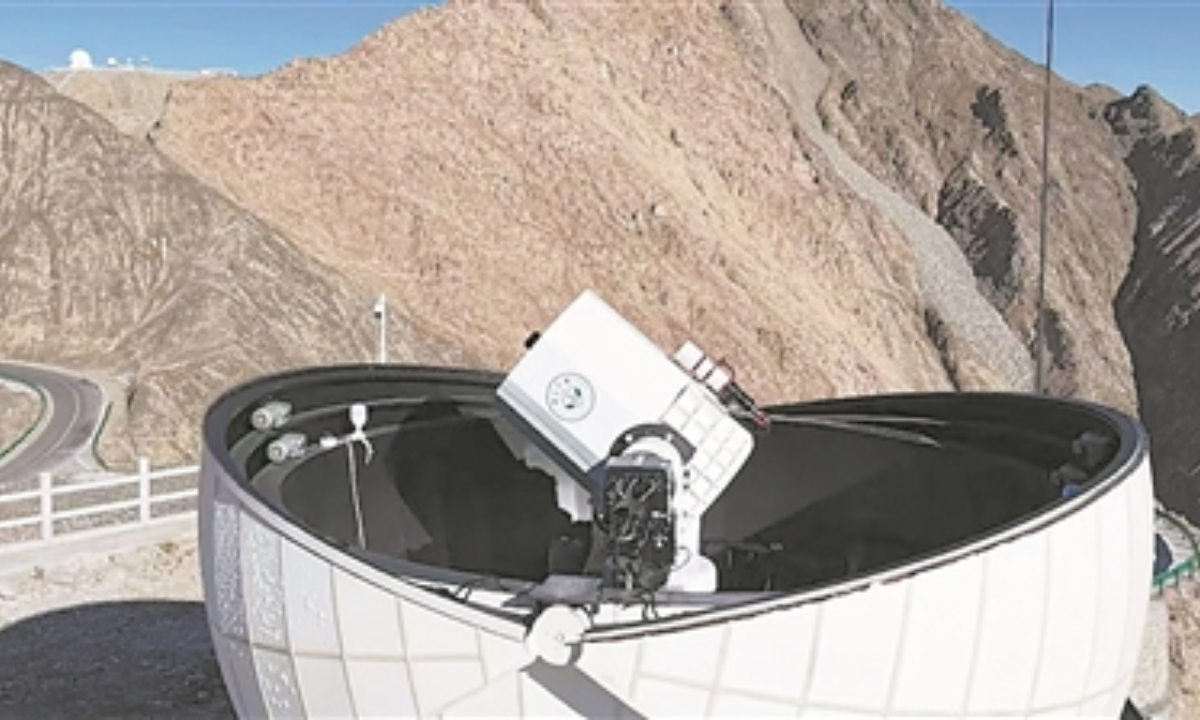
Chinese scientists on Wednesday released the first complete set of observational images captured by China's new-generation ground-based infrared telescope, filling a gap in the country's near-infrared astronomical observation capabilities and reducing reliance on foreign infrared detector technology, China News Service reported on Wednesday.
The 80-centimeter near-infrared telescope was installed at Saishiteng Mountain, Lenghu township, Northwest China's Qinghai Province in October 2024. Jointly developed by Sun Yat-sen University and several partner institutions, the telescope is China's first to achieve scientific imaging in the 1.2-micrometer J band and 2.2-micrometer K band using domestically developed scientific-grade InGaAs and HgCdTe detectors.
The telescope enables unattended remote operations, and can lock onto any target in the sky within 15 seconds. Its infrared capability allows it to see through interstellar dust, enabling it to observe cold and distant celestial objects that are difficult for optical telescopes to capture.
According to Ma Bin, a professor at the School of Physics and Astronomy, Sun Yat-sen University who led the research team that released the infrared telescope's observational images, all three of the telescope's core astronomical observation capabilities were fully validated during operation.
It rapidly responded to and tracked multiple gamma-ray bursts and supernova events, recording the evolution of their infrared afterglows following the explosions. It continuously monitored brown dwarfs, precisely capturing periodic variations in their atmospheric brightness. Using image-stacking technology, it also observed active galaxies billions of light-years away.
Since its deployment in Lenghu, the system has supported infrared observations for more than 10 Chinese research institutions, accumulating valuable experience for the construction of future large-scale infrared telescopes.
Lenghu township, where the world-class astronomical observation base takes shape, is hailed as "the most Mars-like place on the Earth." The astronomical observation base was said to be an astronomical observation site comparable to the top ones in the world by a Nature article published on August 18, 2021, according to the Chinese Academy of Sciences.
Once prospered in 1950s due to its rich petroleum resources, Lenghu is now becoming a premier astronomical observation site and Mars-themed tourist destination, according to Xinhua News Agency.
Global Times
。

二 | (ECNS) -- Wang Xiji, one of the pioneers of China's space program, an academician of the Chinese Academy of Sciences, and recipient of the "Two Bombs, One Satellite" Meritorious Service Medal, died in Beijing on Wednesday at the age of 105 after an illness. The China Academy of Space Technology said his death was a great loss to China's space program, expressing deep condolences and remembrance for the scientist who devoted his entire life to the country's aerospace endeavors. In November 1958, shortly after the launch of the call that "we should also develop artificial satellites," Wang was transferred to the Shanghai Institute of Mechanical and Electrical Design under the Chinese Academy of Sciences, where he became the technical leader for sounding rockets. At the beginning of the project, working conditions were extremely rudimentary. The team had no experience, reference materials or experts, and had to start from scratch. With only hand-operated calculating devices available, several team members worked day and night for more than two months to calculate a single flight trajectory. With no launch site, they used a rice paddy on the outskirts of Shanghai as a makeshift launch pad. They hoisted the rocket onto its launch stand with a winch and pressurized the propellant using a hand pump. On Feb. 19, 1960, Wang and his team successfully launched China's first sounding rocket, the T-7M, from the rice field. Although the rocket reached an altitude of only 8 kilometers, the launch marked a crucial first step in China's journey into space. During the subsequent development of the Long March-1 rocket, Wang innovatively integrated technologies from sounding rockets and missiles. He formulated the technical plan for Long March-1, China's first satellite launch vehicle, and led the development of its overall design and prototype. His work laid an important foundation for the successful launch of China's first satellite. In February 1968, Wang joined the newly established China Academy of Space Technology and continued to devote himself to China's space program. On April 24, 1970, China successfully launched its first artificial Earth satellite, Dongfanghong-1, into space aboard a Long March-1 rocket, becoming the fifth country in the world to independently launch a satellite into orbit. On Nov. 26, 1975, China successfully launched its first recoverable satellite. While the nation celebrated the successful launch, Wang hurried to the satellite tracking and control center, knowing that the mission would not be considered a complete success until the satellite returned safely to Earth. He stayed awake for three days and three nights. Only when he saw the red-and-white parachute appearing in the sky did he finally relax. The successful recovery brought back China's first batch of high-resolution remote-sensing film covering the country, providing basic data for national land surveys, topographic mapping and other applications. China thus became the third country, after the United States and the Soviet Union, to master recoverable satellite technology. Wang said he felt the main meaning of life lies in participating in the great cause of socialist construction and contributing his share to it. "I understand the cause of the Party and have made up my mind to strive to become a Communist," Wang wrote in his application to join the Communist Party of China. He remained committed throughout his life to his belief that "one should strive to be a Communist," and honored his lifelong pledge: "I am willing to be a paving stone for space." (By Gong Weiwei) 
 。
。

三 |
Current article:http://www.mengruanpianchengji.cyou/f20wz/bat.html
Published on:22:59:08