


饭局的诱惑
Huge turnout in Poland's decisive election, highest since 1919_我的网站

A | From 7 a.m. onward Sunday, ballot boxes in Poland started filling up so fast that spare ones had to be dusted off and more ballots needed to be printed. No one had anticipated such long lines throughout the country.Voting was to end at 9 p.m., but by law, polling stations stayed open to accept all who queued up, and the last one closed at 5 a.m. Monday. Some voters braved the night chill for up to eight hours to cast their vote.This resulted in a record turnout of nearly 74% -- highest voter turnout in Poland since 1919 and even higher than that of the first free elections after the fall of communism in 1989.The high turnout confirmed that millions of Poles agree these parliamentary elections may have been the most decisive in the last three decades. Either they would allow the ruling right-wing populist Law and Justice (PiS) party to extend its eight-year hold on power for another four-year term, or they would opt for the return of a liberal democracy.Late poll figures univocally indicate that opposition parties stand a realistic chance to form Poland's next government.The PiS conservatives currently in power took 36% of the vote, but that doesn't translate into a seat majority in parliament, which would allow it to form a Cabinet. Latest polls show they would have 196 deputies in the 460-seat legislature as opposed to 249 seats won by the broad Civic Coalition of opposition parties led by Donald Tusk, former president of the European Council.Sunday's vote was a confrontation of two radically different visions of Poland's future.Conditioned by PiS propaganda that has continually been exploiting fears, PiS supporters claim only that party can secure Poland's sovereignty and protect its interests. The threat of illegal migrants is perhaps the most unifying emotion binding the PiS electorate.Supporters see PiS as their only protector from the alleged dominance of European Union bureaucrats in Brussels and their meddling in Polish affairs.PiS voters turn a blind eye to the fact that the country began to drift toward authoritarian rule, authorities neglect the EU's legal norms and the country continues on a collision course with the Union. Some €36 billion of EU COVID pandemic recovery funds have been frozen in a row over PiS judicial reforms. Many observers believe another PiS term would result in Poland leaving the European Union.Germany, Poland's by far most important trade partner and neighbor, is presented as another source of fear and the country is made out to be an ally of Russia, Poland's greatest foe throughout centuries. But if it's not the threat of German capital buying out Polish industry, then it's the threat of moral decay.In order to appeal to radical voters who accuse the government of extending excessive welfare to Ukrainian refugees, authorities cynically strained relations with Kyiv.PiS voters declare the fear that if the party loses, the next government would take away the generous social benefits PiS guaranteed, such as 14 pensions, child care payments and early retirement.Those who Sunday voted for parties forming the anti-PiS coalition declare they voted for a Poland securely rooted in the European Union.In radio and TV street interviews, they say they want to see Poland mend its strained relations with neighbors, particularly Germany and Ukraine.They do not want to see the Catholic Church influencing state affairs.Sixty-four percent of those polled declare they're in favor of same-sex marriages, and 70% want the new government to liberalize the current strict anti-abortion law.It is uncertain whether Poland's new government will be prepared to meet the more liberal postulates voters expect. The potential ruling coalition's unifying factor is its pro-democratic, pro-EU, anti-PiS stance. Other than that, they often differ in their proposed policies and outlook. They're a broad coalition composed of parties spanning from the far left to liberal conservative.The Civic Coalition's clear victory makes it the only faction in parliament able to constitute Poland's new government. But first, Polish President Andrzej Duda, a PiS nominee, will need to designate a prime minister. Most likely, against the odds, he will name a PiS candidate. That candidate will have little realistic chance of being approved by parliament, and Poland may be faced with many weeks of squabbling and chaos. Constitutionalists predict it may not be until December that Poland gets its new government.。
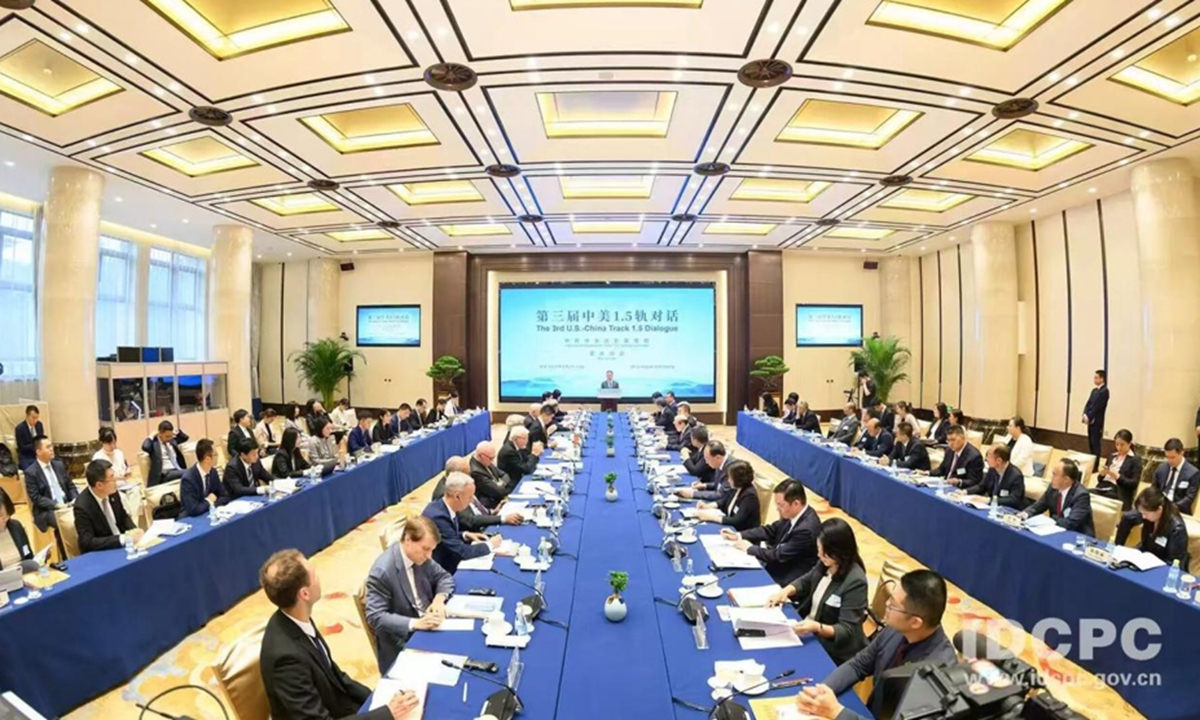
The third China-US Track 1.5 Dialogue was held in Beijing on Tuesday, bringing together government officials, scholars and business representatives from both countries for discussions on constructive strategic stability and practical cooperation.
Co-hosted by the International Department of the Central Committee of the Communist Party of China (IDCPC) and the Asia Society, the dialogue was attended by about 40 representatives. Participants included officials from relevant Chinese government departments and local governments, experts from think tanks and universities, as well as figures from US strategic and business circles, including John L. Thornton, co-chair of the Asia Society Board of Trustees.
Under the theme "Constructive Strategic Stability - Practical China-US Cooperation in the New Era," the participants held candid, in-depth and constructive exchanges, according to the IDCPC's release on its WeChat account on Tuesday.
Addressing the dialogue, Liu Haixing, head of the International Department of the CPC Central Committee, said the two sides have recently followed the direction set by the two heads of state, taken practical steps to strengthen communication and dialogue, advanced a positive agenda and achieved notable results.
Liu called on the two countries to continuously enlarge common interests and make cooperation the anchor of positive stability. He urged the two countries to uphold mutual benefit and reject zero-sum games so that competition remains within bounds, to seek common ground while managing differences, and observe the bottom line of no conflict and no confrontation to achieve lasting peace and stability.
Participants discussed ways to enhance political mutual trust, expand economic and trade cooperation, and explore cooperation in artificial intelligence, science and technology, CCTV News reported.
Established in 2023, the China-US Track 1.5 Dialogue operates between formal government-to-government diplomacy, known as Track 1, and purely nongovernmental exchanges, known as Track 2. The second dialogue was held on June 13, 2024, during which participants held candid, in-depth and constructive exchanges around the theme of "sharing perspectives and finding solutions on key and urgent issues."
As a channel involving both government and nongovernmental participants, the Track 1.5 mechanism can help China and the US communicate more effectively, identify common ground and better understand the consensus reached by the two heads of state, Zhou Mi, a senior research fellow at the Chinese Academy of International Trade and Economic Cooperation, told the Global Times on Tuesday.
It can also help translate the consensus into greater mutual understanding and concrete action, Zhou said.
Discussions on AI at this year's dialogue could help the two sides identify shared interests despite existing frictions and technological challenges, creating opportunities for practical cooperation and laying the groundwork for follow-up efforts, he noted.
Wang Yiwei, a professor at the Renmin University of China's School of International Studies, told the Global Times on Tuesday that the Track 1.5 dialogue serves as a bridge between Track 1 and Track 2, allowing participants to discuss sensitive issues and explore policy space while conveying frontline assessments and feasible proposals to decision-making departments.
Liu outlined practical pathways for China-US cooperation in the new era. First, the two sides should uphold mutual respect, peaceful coexistence and win-win cooperation, steer China-US relations to overcome the "Thucydides Trap," and create a new paradigm of major-country relations.
Second, the two countries should jointly shoulder their responsibilities as major powers, make constructive interaction an important driver of international cooperation, address global challenges together and inject greater stability into the world, Liu noted.
Third, they should expand exchanges and cooperation in trade, public health, agriculture, tourism, people-to-people ties, law enforcement and cooperation between localities, thereby strengthening the resilience of bilateral relations and working toward a better future, Liu said.
Overcoming the "Thucydides Trap" fundamentally rejects the notion that conflict between major powers is inevitable, Wang Yiwei said. It reflects an effort by China and the US to pursue a path different from the historical confrontation between an established power and a rising one.
Such a model does not seek to avoid competition altogether, but to ensure that competition has boundaries, differences remain manageable and cooperation retains sufficient space, Wang Yiwei said.
To put this approach into practice, the two countries should respect each other, avoid crossing red lines concerning core interests and reduce the risk of strategic miscalculation. They should expand areas where their interests converge and establish regular cooperation mechanisms on global issues such as climate change, public health, food security and AI safety, turning shared responsibilities into joint action, he noted.
As the world's two largest economies, China and the US should recognize that many global challenges cannot be effectively addressed without coordination between them, particularly at a time of intensifying competition. Constructive engagement is therefore not a temporary expedient but a long-term responsibility that major countries should undertake for the world, Wang Yiwei said.
The dialogue came a day after China's top political advisor Wang Huning met with US delegates attending the event in Beijing on Monday.
During their meetings, the US side said that the US-China relationship is at a special juncture, adding that the sound rapport between the two heads of state constitutes the most valuable and important part of bilateral ties. The US side agrees that both sides should act on the consensus of building a constructive US-China relationship of strategic stability, advance corporate cooperation, expand people-to-people and cultural exchanges, guard against risks such as those posed by artificial intelligence, and deliver benefits to both countries and the rest of the world, according to Xinhua.
。

B |
Current article:http://www.mengruanpianchengji.cyou/gwqe/h6kx.ppt
Published on:21:25:06
 德拉维多瓦:离开NBA后进入风投领域 继续发挥“疯子”特质
 女子持刀抢劫不果逃跑 警方九小时内逮到人
 Winston Peters再次担任代总理 Luxon前往澳洲参加女儿毕业典礼
 取胜之匙!绿军自马祖拉执教后 三分命中率40+%的比赛101胜8负
 Global Smart Education Conference 2026 held in Beijing
 DPP authorities’ excuses for blocking youth service platform are nothing but separatist rhetoric: mainland spokesperson
 抚顺全城行动 为文明养犬打call!
 弗里克:不清楚莱万将伤缺多久,托雷斯状态堪称完美
 兽用精神药品随意售卖,制毒不法分子盯上兽用麻醉药品
 Claude据悉正在调查Mythos 5、Fable 5、Opus模型错误率异常升高的问题
 切尔西球迷质疑雅克松:他根本不是一名前锋,他总是离球很远
 《劲舞团》2026城市巡回赛天津站—青春返场,热舞收官!