放牛班的春天
女子称一个月光洗澡燃气费130多元 燃气公司回应多种因素_我的网站

A | 近期,南京市民在社交媒体上广泛讨论家庭燃气费用的异常增加,特别是免费更换智能燃气表后,部分用户用气量似乎“直接翻倍”。 目前,南京主城区燃气由港华燃气供应,江北由中燃燃气供应,江宁由华润燃气供应。
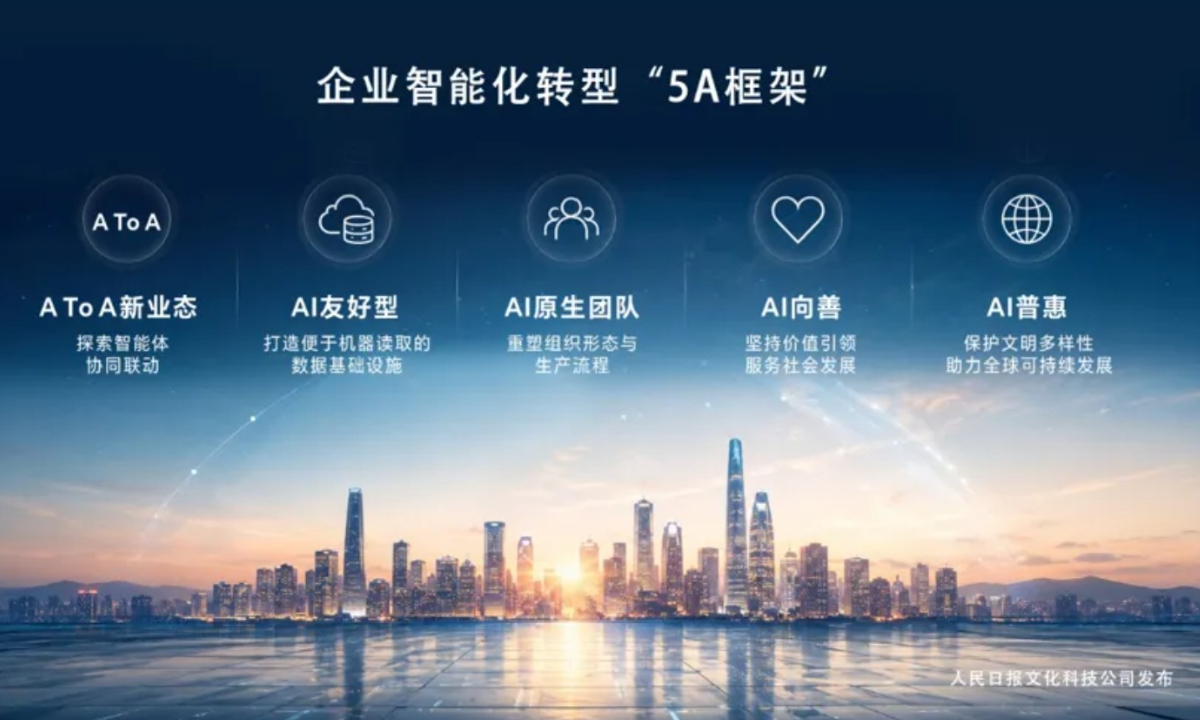
The 2026 Digital Intelligent Economy Forum was held in Langfang, North China’s Hebei Province, on Wednesday. At the forum, organizer People's Daily Cultural Technology Corporation unveiled a “5A Framework” for enterprise intelligent transformation, aimed at helping businesses comprehensively innovate their business models, organizational structures and service systems in the artificial intelligence (AI) era.
A To A: Exploring new models for agent collaboration
AI is pushing the internet into a new stage characterized by the widespread participation of AI agents. In the future, China could develop an ecosystem comprising tens of billions of agent applications, while the global “digital population” could reach hundreds of billions. Following To B (business-oriented) and To C (consumer-oriented) models, enterprises and institutions should actively explore the emerging To A (agent-oriented) model. To enable better interaction and coordination among agents, unified data, technology, interface and service standards need to be established, while new business systems and service models should be cultivated.
AI-friendly: Building machine-readable data infrastructure
Today’s internet user interfaces are primarily designed for human browsing. The first step, therefore, should be to build an “AI-friendly” data system that is better suited to being read, understood and accessed by AI. By structuring content resources and turning them into organized knowledge, while strengthening ontology systems and knowledge graphs, such a system can improve AI’s ability to understand and apply information. On this basis, integrated hardware and software infrastructure combining computing architecture with data systems can be developed for AI applications.
AI-native teams: Reshaping organizations and workflows
AI is profoundly reshaping organizational structures and ways of working. AI-native teams should redefine job responsibilities, organizational structures and business processes around the A-To-A model and AI-friendly services, enabling “everyone to have multiple AI agents.” Professional capabilities and business experience can be encapsulated into “digital employees,” promoting autonomous learning by agents, multi-agent collaboration and the evolution of collective intelligence, thereby multiplying per-capita productivity.
AI for good: Putting values first, serving social development
AI also requires values-based guidance. Guided by the principle of “being people-centered and using AI for good,” efforts should follow the approach of “governing AI with AI and guiding intelligence with wisdom,” ensuring that AI always serves social development, the public interest and people’s needs. The “Mainstream Values Corpus,” whose development was launched by the People’s Daily in May 2023, has already begun to take shape and has been validated through numerous large-model applications.
Inclusive AI: Protecting cultural diversity, advancing global sustainable development
AI should not become merely “a game for rich countries and rich people,” but should benefit all countries. Efforts should be made to actively participate in global initiatives for inclusive AI, bridge the digital and intelligent divide, and enable more organizations and individuals to share the benefits of development on an equal footing, so that AI can truly become a powerful positive force for improving the well-being of all humanity and advancing human civilization.
This was translated and compiled by the Global Times, based on an article originally published on people.cn on August 12, 2026.
。从去年下半年起,南京中燃为天然气用户陆续免费更换智能燃气表,有部分用户使用了一段时间后,对新表计量的准确性提出了质疑。对此,南京中燃从3月21日开始,就在其公众号上发表“用户反映气费增多?解答来了”的文章。其中也主要提出价格调整使得气费增加,还提到“实际上,冬季用气量增多、人工抄表误差以及旧表零部件老化等原因,都有可能让用户感觉新表走得快。” 港华回应 记者了解到,2023年7月1日起,南京居民气价执行宁发改价费字【2023】410号关于《市发改委关于调整居民用管道天然气销售价格有关事项的通知》。

B | 调整居民用气各档销售价格。按照第一、二、三档价格1:1.2:1.4的价差比例,居民用气各档销售价格分别调整为3.03元/立方米、3.64元/立方米、4.24元/立方米,分别上调0.30元/立方米、0.36元/立方米、0.42元/立方米。

C | 除了价格调整,其他政策保持不变,全市居民用管道天然气继续实施阶梯气价政策,同城同价,居民用气第一、二、三档销售价格价差比例保持1:1.2:1.4不变,阶梯气量、计量缴费周期等政策保持不变。(中国小康网综合“南京港华燃气有限公司”企业微信公众号、顶端新闻、紫牛新闻)。
Current article:http://www.mengruanpianchengji.cyou/ig144/20260826/5061382.ppt
Published on:03:58:42